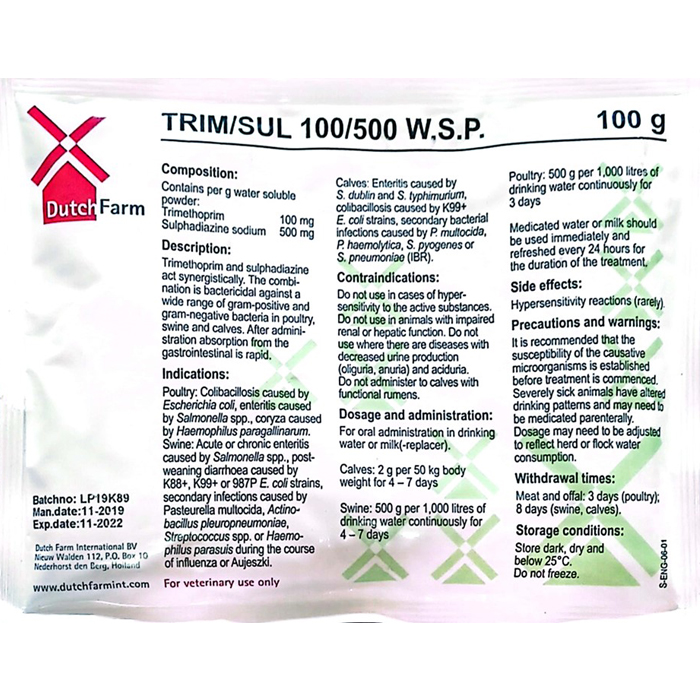
Contains per g water-soluble powder:
Trimethoprim………………………………………………….. 100 mg
Sulphadiazine sodium ……………………………………… 500 mg
Trimethoprim and sulphadiazine act synergistically. The combination is bactericidal against a wide range of gram-positive and gram-negative bacteria in poultry, swine and calves. After administration absorption from the gastrointestinal is rapid.
Poultry : Colibacillosis caused by Escherichia coli, enteritis caused by Salmonella spp., coryza caused by Haemophilus paragallinarum.
Swine: Acute or chronic enteritis caused by Salmonella spp., post – weaning diarrhea caused by K88+, K99+ or 987P E.coli strains, secondary infections caused by Pasteurella multocida, actinobacillus pleuropneumoniae, Streptococcus spp. or Haemophilus parasuis during the course of influenza or Aujeszki.
Calves: Enteritis caused by S.dublin and S.typhimurium, colibacillosis caused by K99+ E.coli strains, secondary bacterial infections caused by P.multocida , P.haemolytica, S.pyogenes or S.pneumoniae (IBR).
Do not use in cases of hypersensitivity to the active substances. Do not use in animals with impaired renal or hepatic function. Do not use where there are diseases with decreased urine production (oliguria, anuria) and aciduria. Do not administer to calves with functional rumens.
For oral administration in drinking water or milk (- replacer).
Calves - 2 g per 50 kg body weight for 4 – 7 days.
Swine - 500 g per 1,000 litres of drinking water continuously for 4 - 7 days.
Poultry - 500 g per 1,000 litres of drinking water continuously for 3 days.
Medicated water or milk should be used immediately and refreshed every 24 hours for the duration of the treatment.
Hypersensitivity reactions (rarely).
It is recommended that the susceptibility of the causative microorganisms is established before treatment is commenced.
Severely sick animals have altered drinking patterns and may need to be medicated parenterally.
Dosage may need to be adjusted to reflect herd of flock water consumption.